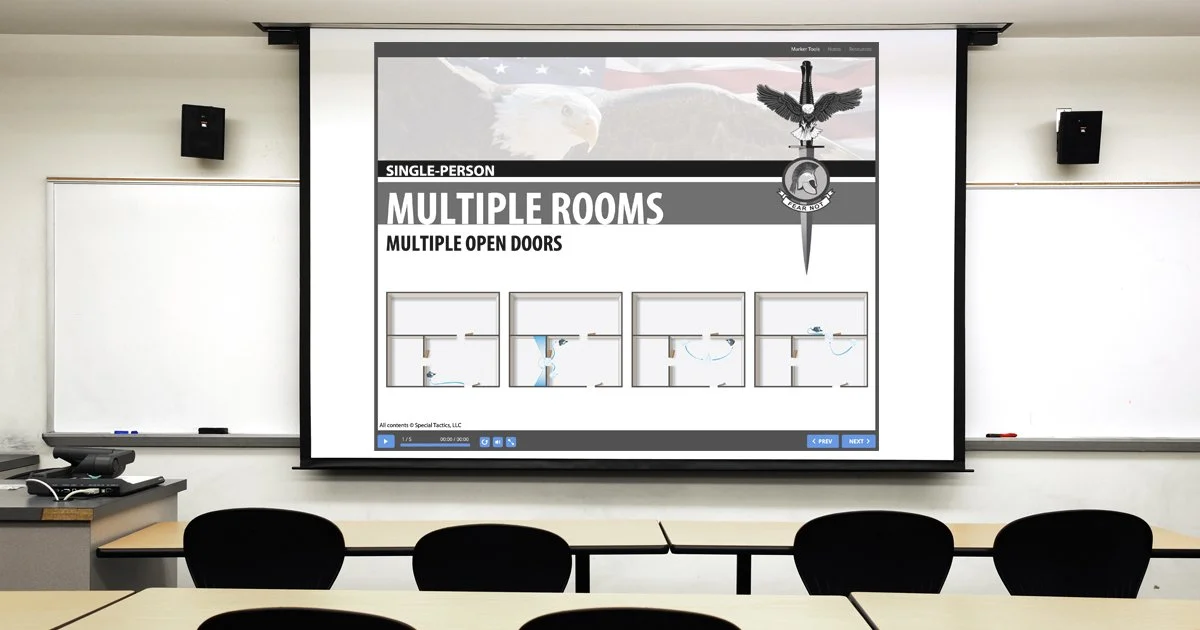
Special Tactics is the first tactical training school to seamlessly integrate in-person training, multimedia online courses and detailed manuals with full-page color illustrations, developed by special operations veterans from Tier-1 Special Mission Units, along with a team experts with diverse backgrounds from the military, law enforcement and academic communities.
Check our latest blog articles and share your opinions with other tactical professionals on our various social media sites. Or, browse our library of past articles covering a wide range of tactical subjects.
The first two installments of our four-part article on school/church defense focused on the importance of integrating on-site armed guards and auxiliary security/support personnel with local law enforcement and offered seven suggestions for employing armed guards for school defense. This article deals with the incorporation of “auxiliary security assets” into the overall security plan. While this article references “school security,” the same principles can be applied to church security and other community facilities.
The last article on school and church defense focused on the importance of integrating three elements into a cohesive plan of action: On-site armed guards, auxiliary security/support personnel and local law enforcement. In this second part of the 4-part article, we will focus on seven suggestions for employing armed guards for school defense and how to integrate those guards into a larger plan/drill for responding to a deadly attack.
The Special Tactics staff offers our prayers for the victims of the tragic school massacre in Uvalde, Texas and for the families who lost loved ones. Unfortunately, it seems clear that we have not seen the end of this rising trend of violent attacks. We want to do everything we can to help prevent future killings or at the very least reduce their number. Several years ago we published a 4-part article series (on our old website) covering Tactical School/Church Security and Active Shooter Response. We are re-publishing that article series here starting with the first part on an “Integrated Approach” to security.
We have recently received some requests from instructors, asking for permission to use our presentations and learning materials in their own tactical schools and courses. The good news for those instructors and all the other tactical instructors out there is that you do not need permission to use any of our materials in your own training. Just like a high school teacher does not need to get permission from the textbook publisher to use a textbook in his/her class, any tactical instructor or school can use any of our materials, as long as they don’t steal them or break any copyright laws. If you are interested in using our materials for your course or school this article includes a few suggestions and ideas that might help.
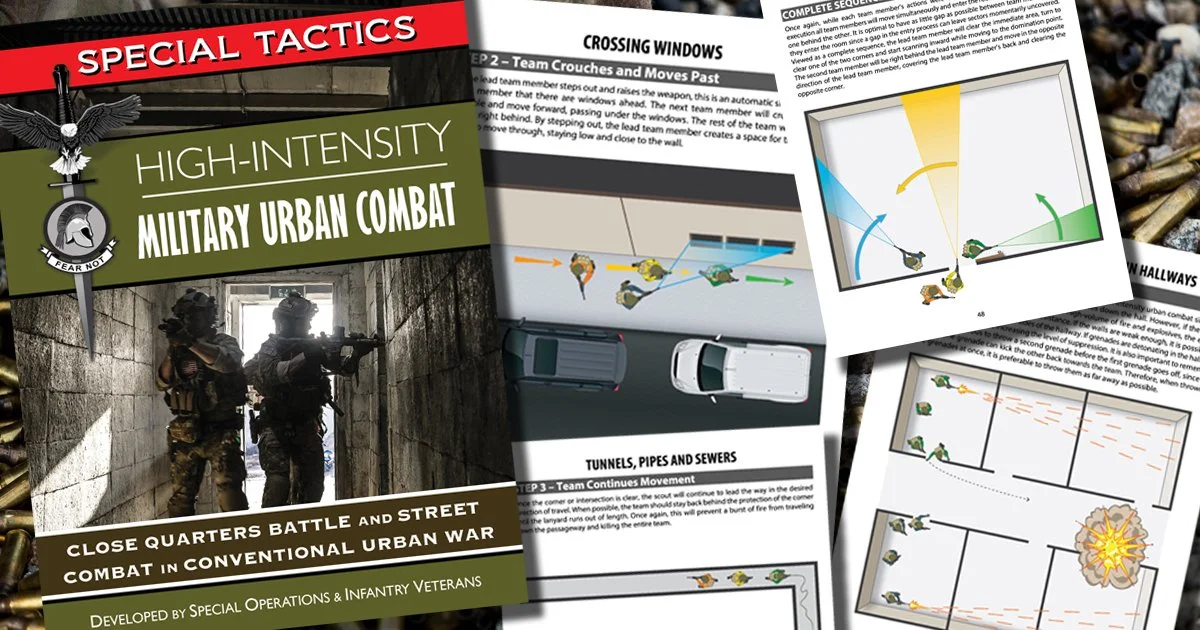
Our new High-Intensity Military Urban Combat book is an abridged version of the longer Squad-Level Military Urban Combat manual published by Special Tactics in 2017 which required controlled distribution and could not be published digitally because it contained sensitive but unclassified information regarding U.S. military urban warfare tactics. This version has extracted two sections from the original manual that contain no sensitive information, making this abridged version suitable for international, digital distribution. The core value provided by this new manual is a focus on the often neglected subject of high-intensity conventional warfare. Such tactics and knowledge could prove particularly useful for allied military forces as conventional conflicts grow more common around the world.
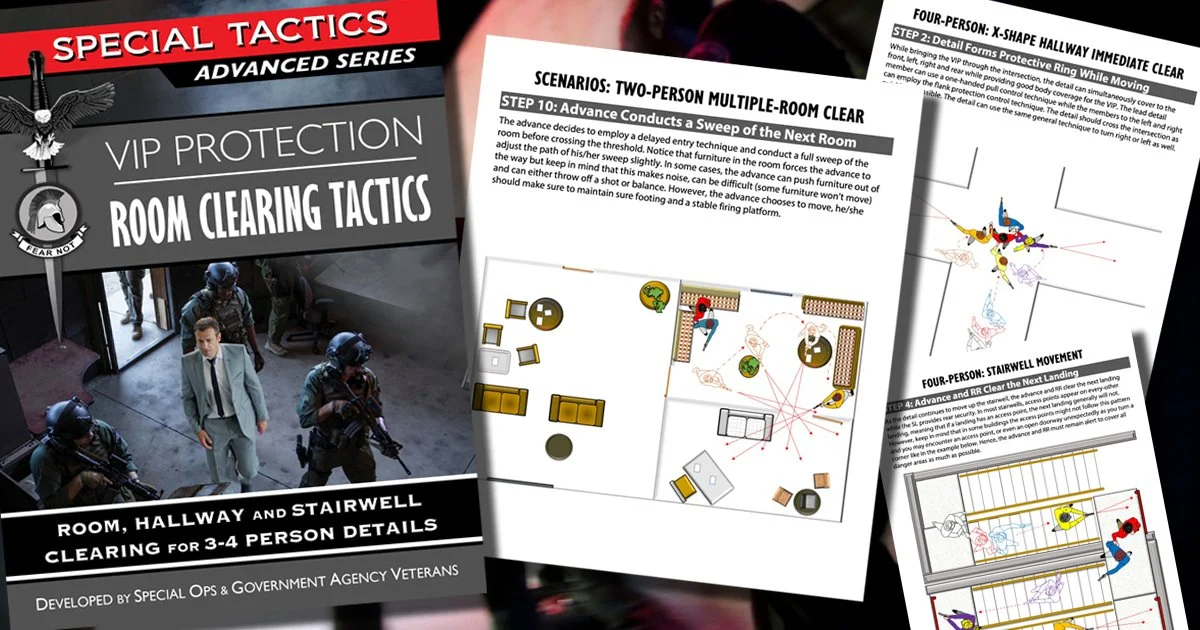
Our latest book focuses on room clearing tactics (RCT) as they apply to VIP protection work. The book is the first volume in Special Tactics’ new advanced series. The term “advanced” does not necessarily mean that the techniques themselves are more advanced. The book still focuses on basics and fundamentals but instead of covering individual techniques, it focuses on providing more real-world, scenario-based examples of how to combine various techniques to solve tactical problems.
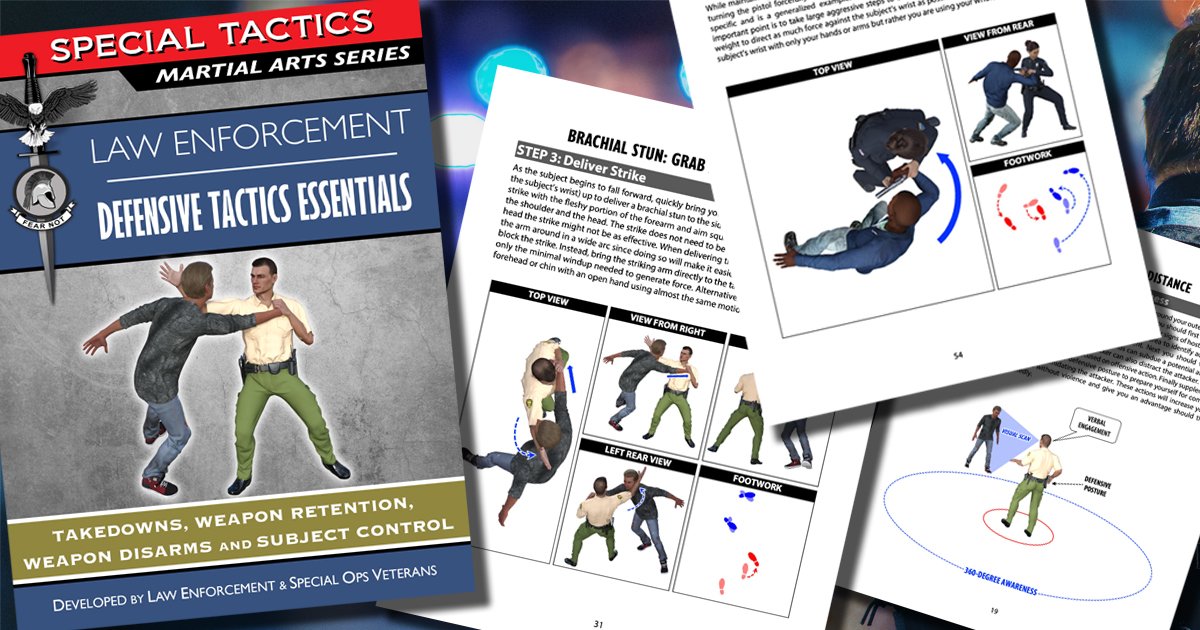
Law enforcement officers are currently facing some of the most difficult and confusing challenges they have encountered in recent history. Crime, violence, and civil disobedience are rising around the world. At the same time, social trends have in many cases turned public opinion against the police, limited police funding and placed increased restrictions on police use of force. Given the current lack of funding, resources and manpower there is a need for defensive techniques and training methods that can achieve effective results with minimal training time. The Special Tactics Fighting Art (STFA) offers an approach that can allow officers to achieve high levels of performance in a short time by ensuring techniques are as simple as possible, easy to learn, and easy to apply under great stress.
The ambush is one of the most commonly practiced but least understood tactical skills in the modern U.S. military. This short article is taken from our new Small Unit Infantry Ambush Tactics book. The article is drawn from the book’s introduction and discusses how the doctrinal “schoolhouse” mentality has caused many small unit leaders to forget the hard-earned ambush lessons of previous conflicts.
We are happy to announce that our Outcomes Based Learning Professional Handbook is now available in hardcopy (paperback) from our online store. Emphasizing realistic, scenario-based evolutions, the OBL approach greatly improves combat effectiveness. Embedded in this post are links to both the hardcopy and e-book versions as well as re-prints of the last two articles taken from the OBL book.
Our latest book goes into detail on a wide range of topics relating to home defense and security while providing examples of effective tactics and techniques that can help you protect yourself and your family. This article takes a few passages and diagrams from the sections on alert plans, neighborhood security and response. The full book goes into more detail on this topic also and covers personal response and law-enforcement response to a home invasion.
LEADER DEVELOPMENT: Special Tactics training builds confidence, moral courage and other key leadership traits among all students, regardless of age, or position. The most effective organizations start building future leaders early and recognize that in an emergency situation, anyone might have to assume a leadership role.
FASTER PERFORMANCE ENHANCEMENT: Special Tactics’ innovative, hands-on training methods, developed by Tier-1 special operations veterans and grounded in cutting-edge scientific research, build critical skills and professional knowledge much more quickly than traditional classroom or lecture-based learning models.
INCREASED ADAPTABILITY: Unlike many training programs that focus on rigid processes, rote memorization, and predictable “canned” scenarios, Special Tactics training emphasizes adapting to the unexpected and making bold, timely and creative decisions in a rapidly-changing, highly-uncertain environment.
IMPROVED JUDGEMENT, RISK MITIGATION AND SAFETY: Training incorporates detailed risk assessment, risk mitigation and safety measures into every aspect of training. This emphasizes the importance of responsibility and sound judgement at all levels while still empowering leaders to take calculated risks when necessary.
KNOWLEDGE AND SKILLS SUSTAINMENT: Skills are perishable and over time, students forget what they learned in a course if there are not effective sustainment tools available. Special tactics provides all students with an integrated suite of multimedia sustainment products including reference manuals and online courses.
A “LEAD FROM THE FRONT” MINDSET: When leaders demonstrate proficiency in hard skills and lead by example, this builds great trust and respect among subordinates. Special Tactics training emphasizes this bold and engaged leadership style, generating a positive command climate and increasing unit effectiveness.